

Missed the total lunar eclipse? Here’s where to catch the Blood Moon in UAE tonight
Last chance to witness the rare celestial event
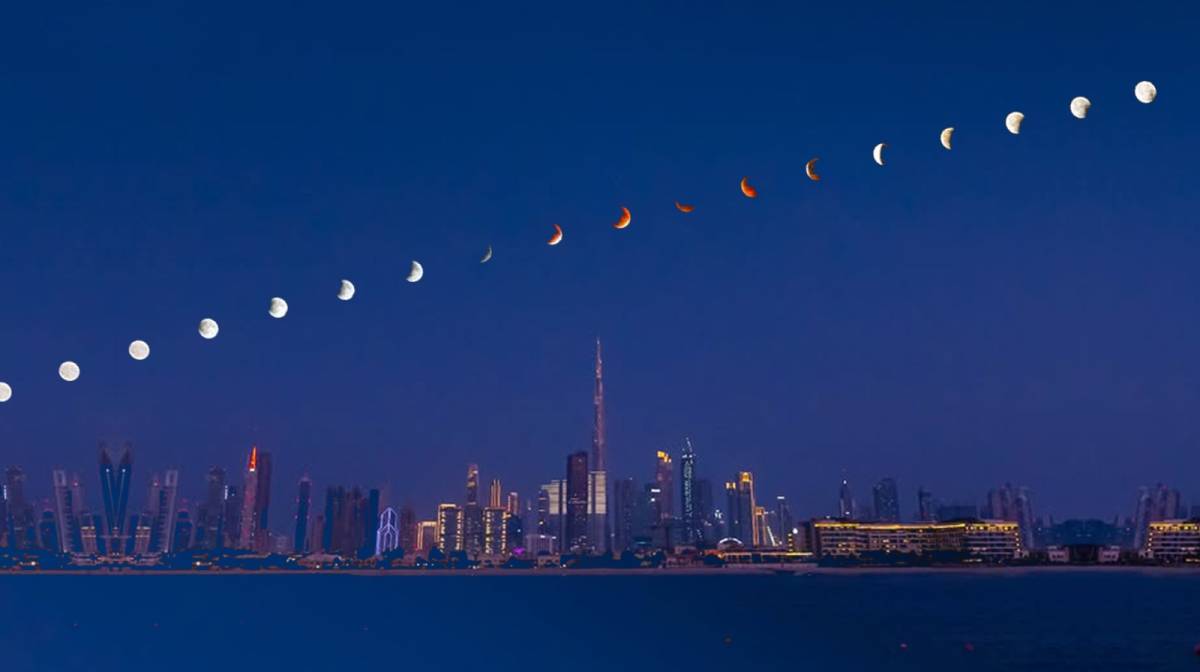
DUBAI — A rare Blood Moon dazzled UAE skies on Sunday night, drawing thousands of stargazers to public events and outdoor viewing spots.
The phenomenon, caused by a total lunar eclipse, reached its dramatic peak at 10:12 pm GST, when the Moon turned a deep copper red during 82 minutes of totality. The event, which spanned more than five hours, remained visible across all seven emirates until just before 1am.
The Blood Moon was visible to about 87 percent of the world’s population, stretching from Asia to Africa, Europe and Australia. In the UAE, its visibility makes it a landmark astronomical event of 2025.
But for those who missed the main spectacle yesterday, there is still a chance to see the Moon bathed in reddish tones as the eclipse continues into Monday morning, 8 September. With clear skies forecast across much of the UAE, residents can still look up tonight to witness one of the longest eclipses in recent years.
What is Blood Moon?
A Blood Moon occurs during a total lunar eclipse when the Earth moves directly between the Sun and the Moon. Instead of vanishing, the Moon takes on red and orange hues because sunlight bends through Earth’s atmosphere. Blue wavelengths scatter more easily, leaving only the longer red tones to illuminate the lunar surface.
Where to watch in UAE
From iconic landmarks to remote desert horizons, UAE residents have several vantage points to catch the final stages of the Blood Moon:
Mohammed bin Rashid Library, Dubai: Dubai Astronomy Group hosted a major event here, complete with telescopes, astrophotography workshops and expert talks. Tickets cost Dh250 ($68) for adults and Dh200 for children, while the event is also streamed globally.
Al Qudra Desert & Al Marmoom Reserve, Dubai: Far from city lights, these spots offer uninterrupted views of the Moon over golden dunes. Both sites feature observation decks perfect for stargazing.
Dubai Desert Conservation Reserve: Here, visitors can combine luxury desert safaris with stargazing through telescopes in a traditional Bedouin-style setting.
Hatta, Dubai: Nestled in the Hajar Mountains, Hatta offers wide horizons for moon watching. Visitors can extend their trip with hiking or camping options.
Mleiha National Park, Sharjah: Surrounded by archaeological landscapes, this spot doubles as a desert lounge for skywatchers seeking darker skies.
Al Quaa Milky Way Spot, Abu Dhabi: Famous for pristine night skies, this location lies 90 minutes from Abu Dhabi towards Al Ain. A 4×4 is required to access it, but it offers one of the darkest skies in the UAE.
Al Sadeem Astronomy Centre, Abu Dhabi: Opened in 2016, the centre provides guided tours and telescope viewings by booking only, priced at Dh300 for adults and Dh100 for children.
Shuweihat Island, Abu Dhabi: A four-hour drive from Dubai, the island is known for its salt flats and remote stargazing. A 4×4 is recommended for access.
Jebel Jais, Ras Al Khaimah: At the UAE’s highest peak, stargazers can watch the Blood Moon with minimal light pollution and panoramic mountain views.
Tips for skywatchers
The Blood Moon can be viewed safely with the naked eye, unlike solar eclipses. Experts recommend binoculars or telescopes for sharper detail, while astrophotographers are advised to use tripod-mounted cameras to capture the red tones vividly.
Arriving early at chosen locations is advisable, as some areas draw large crowds. Essentials such as water, snacks and warm clothing are recommended for those venturing into the desert or mountains.
For residents unable to travel, the Dubai Astronomy Group is livestreaming the eclipse globally, collaborating with more than 20 astronomy groups across six continents.
The group is also showcasing a timelapse of the Blood Moon gliding past Burj Khalifa, captured by Dubai-based photographer Rami Dibo.